|
|
 Barack Obama went bowling in an attempt to win the hearts of Pennsylvania’s blue-collar voters. According to serious pundits (including Jon Stewart), however, his dismal bowling failure chinks his rock-star armor and casts doubt on everything from his manliness to his personal character.
Obama dropped by the Pleasant Valley Bowl (Altoona, Pennsylvania’s “Hottest Night Spot“) and tossed a bowling ball for the first time in 30 years. He threw a couple gutter bowls, went for seven frames until he scored a spare, and then called it a day. Final score: a pitiful 37 out of 300 possible points.
The Baltimore Sun consoles him: “From a public relations standpoint, it was a ten-strike.” The Sun may have spoken too soon.
Sports pundits were hardly impressed. According to Media Matters, MSNBC’s Joe Scarborough mocked Obama as “dainty,” said “Americans want their president, if it’s a man, to be a real man,” and doubted the tie-wearing, book-reading candidate’s effectiveness in winning working class voters. NBC’s Harold Ford defended Obama’s athleticism and fawned a bit: “It showed a human side to him. … It showed a very humble side to him.”
Conservatives were even less impressed. Over in National Review’s Corner, Byron York speculated that Obama has alienated “those blue-collar workers who are said to be the key to victory.” Michael Goldfarb found much significance in the fact that Obama stopped at the seventh frame: “Quitting and making excuses when things get tough…it doesn’t bode well. … It would be nice if Obama showed a little resolve in anything but sticking by his anti-Semitic preacher.”
Jon Stewart echoed their concerns on a Daily Show segment mocking media coverage: “How can you keep our jobs from going overseas when you can’t even keep the ball out of the gutter?”
On April Fool’s Day, Hillary Clinton herself took the opportunity to posture as the tougher, more experienced bowler and (of course) mention that 3 a.m. phone call again:
I’m prepared to play this game all the way to the 10th frame. And when this game is over, the American people will know when that phone rings at 3 a.m., they’ll have a president who’s ready to bowl on Day One.
Posted in Campaign 2008, Front Page, The Nation | 10 Comments »
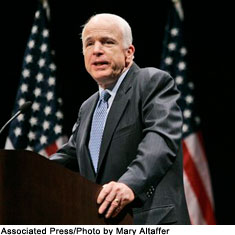 For conservatives who oppose the Iraq war, does John McCain—thoroughly unconservative to many of them—offer any compelling reason to vote for him in November? Right now, a majority probably believes he does. But reasons for thinking he doesn’t are gaining currency. McCain’s pool of voters shrunk by two last week when a couple notable conservative Catholics defected and endorsed Barack Obama. The surprise endorsements have since propelled the conservative blogosphere into an introspective reflection about whether McCain is in fact a good gamble.
Not surprisingly, the two endorsers, who as strong Catholics comprise a demographic sought after by Obama’s campaign, say they hung their cross-party hats on the Iraq war issue. The first was Doug Kmiec (noted in WoW here), head of the Office for Legal Counsel in the Reagan and elder Bush administrations, who wrote in his announcement in Slate that, while conservatives might consider his Obama support “party or intellectual treachery,” he believes Obama, though he may disagree, “will respect and accommodate” discussion from both sides.
The second was Andrew Bacevich, a professor at Boston University whose son, a soldier, died in Iraq in May 2007. Bacevich outed himself in The American Conservative, Pat Buchanan’s paleoconservative magazine, claiming that “[f]or conservatives, Obama represents a sliver of hope. McCain represents none at all. The choice turns out to be an easy one.”
The endorsements have led to endless back-and-forths over whether anti-Iraq war, pro-life conservatives should let their war opposition trump the possibility of getting enough solidly conservative Supreme Court justices, through McCain nominations, to finally overturn Roe v. Wade. (Justice John Paul Stevens is 87; two others are over 70.) In weighing McCain, conservative pundits have especially narrowed in on whether, even if Stevens and others were replaced, Bush appointees John Roberts and Samuel Alito would vote to overturn Roe. (During his confirmation, Jack Balkin has pointed out, Roberts may have betrayed the answer when he told the Senate that Roe was the “settled law of the land.”)
At his Atlantic blog, Ross Douthat argues that “to vote for Barack Obama in 2008 is to give up on overturning Roe for at least a decade, probably for two, and possibly for all time.” Douthat challenges Bacevich to make a “more detailed case for why issues of war and peace ought to outweigh the abortion issue for pro-life voters in ’08.”
Writing in Taki’s Magazine earlier this week, meanwhile, Dan McCarthy made a detailed case for why the Iraq war should trump abortion, adding that conservatives should furthermore take “a true pro-life position” by being against both the war and abortion. And Daniel Larison, who blogs at The American Conservative’s site, contends that Bacevich and Kmiec’s support for Obama “on an issue of war and peace is much more likely to lead to the desired result in the foreseeable future than voting based on the promise of future judicial appointments, whose ultimate decisions in a case many years down the road may or may not lead to the overturning of Roe.”
Still, Jim Antle, associate editor of The American Spectator, argues that Democrats have done far less to “mitigate the war” than Republicans have done to reduce the number, and restrict the availability, of abortions. (Though beyond voting against the original authorization or funding it since, it’s not clear what Antle believes Democrats were to have done.)
“There are plenty of Catholic voters, a real swing voting bloc, who oppose both the Iraq war and abortion,” muses Antle. “How many of them will side with Bacevich and Kmiec rather than the Ross Douthats who vote on the abortion issue?”
Posted in Campaign 2008, Front Page, The Nation | 20 Comments »
 Pollsters may have given Pennsylvania to Clinton, but Pennsylvania voters have yet to do so. With the state’s considerable student population and minority voting blocs, the New York senator may find her lead in the Keystone State somewhat difficult to preserve.
Clinton’s double-digit lead in Pennsylvania opinion polls (she leads 49% to 39% in a Rasmussen poll from March 25) is not news. Obama has been floating almost 10 points behind her for months. With Philadelphia’s 43% black population likely to lean towards Obama, Clinton’s lead relies primarily on support from the Pittsburgh region and the middle of the state.
That support, however, may prove less than stable. Figures from the Federal Election Commission show Obama now leads in monetary support from the Pittsburgh region. With $356,277 total raised at the end of February, Obama has overwhelmed Clinton’s total of $210,471. The Clinton campaign trails behind even the now-defunct Giuliani campaign, which picked up $315,110 from the Pittsburgh area before dropping out of the race in January.
Alongside the superior fundraising, Obama has also recently gathered the support of popular Pennsylvania Sen. Bob Casey, who defeated Sen. Rick Santorum in a landslide 2006 election. The national significance of Sen. Casey’s support was underscored by renewed calls for Clinton to step out of the race on Saturday.
Perhaps the most dangerous element for Clinton, however, is time. Obama’s widening lead in national polls (up to 50% against 43% on March 29) may only further dishearten Clinton supporters as the month drags on towards April 22.
Posted in Campaign 2008, Front Page, The Nation | 9 Comments »
 The good news for Barack Obama: When he appeared on The View yesterday, Barbara Walters told him he was “sexy looking.” The bad news: As Slate V demonstrates, Obama Girl actually makes people – especially women – like Obama less.
Although Obama’s bounced back in the polls, the Rev. Jeremiah Wright continues to haunt him. In response to a query from The View’s slightly dim Elisabeth Hasselbeck, Obama gently asked how she would feel if someone compiled a video of the five stupidest things she had ever said. Bloggers quickly obliged.
John McCain outlined his economic views and his plan to solve the housing crisis. Hillary Clinton’s response still harps on that 3 a.m. phone ad: “It seems like if the phone were ringing, [McCain] would just let it ring and ring and ring.” Disappointingly, says The Washington Post, presidents never really answer 3 a.m. phone calls at all.
And the Clinton campaign goes on for as long as that phone call. Slate’s Hillary Deathwatch sounds a funereal note: “Hillary Clinton is as good as dead.” Obama says the Democratic race is like a good movie that has gone on too long and Clinton later snaps, “I like long movies.” Patrick Leahy doesn’t. At this point, says Chris Orr, Clinton has joined the Vast Right Wing Conspiracy.
McCain also gave a foreign policy speech that promised a more collaborative approach. Think Progress scooped a big story – McCain’s speech plagiarizes an admiral! – only to discover that the admiral plagiarized McCain.
GQ and The Washington Post profiled Meghan McCain, John McCain’s hipster daughter. She blogs, agrees that Obama is sexy, aspires to fashion design, and totes a large, offensively nicknamed suitcase. Michelle Cottle says an adoring press gives Meghan a pass on the suitcase.
Posted in Campaign 2008, Front Page, The Nation | 4 Comments »
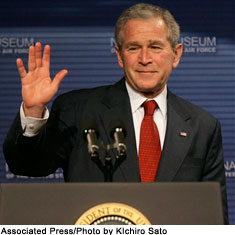 When your country is about to have a major election, it’s a good time to observe the proceedings from a perch somewhere outside of it. In 1979 at Harvard, Russian historian Alexandr Solzhenitsyn made a few observations, from which I select these snippets:
Regarding the choosing of Presidents: “It is not possible that assessment of the President’s performance should be reduced to the question of how much money one makes or to the availability of gasoline….”
Regarding cozying up to China, suddenly a sticky issue in the present Tibetan troubles: “I would not wish such an outcome to any country in the world. First of all, it is…a doomed alliance with evil….”
Regarding terrorists: “Life organized legalistically has shown its inability to defend itself against the corrosion of evil…When a government earnestly undertakes to root out terrorism, public opinion immediately accuses it of violating the terrorists’ civil rights….”
Regarding the use of diplomacy with certain nations: “The truth is that the split is both more profound and more alienating…than one can see at first glance….The anguish of a divided world gave birth to the theory of convergence….It is a soothing theory which overlooks the fact that these worlds are not at all evolving toward each other and that neither one can be transformed into the other without violence.”
Regarding politicians: “Political and intellectual functionaries exhibit this depression, passivity, and perplexity in their actions and in their statements, and even more so in their self-serving rationales as to how realistic, reasonable, and intellectually and even morally justified it is to base state policies on weakness and cowardice.”
Posted in Campaign 2008, Front Page, The Nation | 6 Comments »
 The Democrat who wins Pennsylvania will have to court the Catholic vote. According to AP, Pennsylvania’s 3.8 million Catholics make up 30 percent of the state’s population. So far, Clinton has a hefty 70-24% lead among Pennsylvania Catholics.
Clinton has always had an edge among Catholic voters. She handily won the Catholic vote in Ohio and Texas, and according to a recent Gallup poll she still leads among Catholics by almost 20 percentage points. Among white Catholics, she gets 57% to Obama’s 34%. Among nonwhite Catholics – mostly composed of Hispanics – she leads 53% to 42%.
Why is Hillary winning the Catholic vote from Obama?
The Wall Street Journal says Catholics liked Clinton’s husband and approve of her emphasis on universal health care. Clinton also has supporters among white working-class voters and Hispanics, traditionally Catholic voters.
In an interview with God-o-Meter, Catholic Republican and Obama endorser Doug Kmiec speculated that Catholics support Hillary because Obama voted against the Infant Protection Act. Michael Sean Winters says Clinton could gain points with Catholics by positioning herself as a more moderate candidate on the abortion issue. Obama could do the same to persuade pro-life Catholics like Kmiec, who says trying to change abortion law is “a bit of a fool’s game,” and pro-lifers should instead focus on changing “the heart of the individual person and the attitude of the larger culture.”
The racial divide matters, too. Kmiec notes that Hispanics are heavily Catholic and divided from African Americans. On Artvoice.com, former Democratic consultant Bruce Fisher sees a divide between white Catholics and black Protestants. The white Protestant evangelical religious experience — “boisterous, enthusiastic, demonstrative” — is familiar to most Africans Americans but “alien, uncomfortable and more than a little bit threatening to Catholics.”
InsideCatholic.com editor Deal W. Hudson advises Obama to use pro-life Catholic supporters like Timothy Roemer and to find common ground with social conservatives on issues like illegal immigration and faith-based initiatives. It’s advice Obama should heed, especially if he and John McCain end up vying for the support of a voter group that makes up 25% of the general electorate.
Posted in Campaign 2008, Front Page, The Nation | 10 Comments »
 The irony wasn’t lost on me. The only thing that would have made it more delicious would have been if he had come to Eugene, Oregon, on Palm Sunday rather than on Good Friday. And if his supporters had been waving palm fronds rather than “Change You Can Believe In!” placards. The Obama phenomena has risen to the level of religious, almost messianic fervor.
I see among many of the young a hopelessness that is almost tangible. Alongside that is an inability to trust others and to believe in ultimate truths and values. The mantra is that authority cannot be trusted and that the loudest voices in society want to do nothing more than “sell” something. Broken homes have created a generation with absolutely no one to look up to and to turn to for advice. So direction is lacking, commitment is rare, and despair is rampant.
Barack Obama strides into that void. While voicing “other worldly” themes he suggests “this world” solutions. His soaring oratory and his ambitious promises make his appeal to hope and his drive for change seem reasonable and attainable. He appeals to all that is innate and created in us in a longing for that “better country, that is a heavenly one” discussed in Hebrews 11. And he offers fulfillment in his election to the presidency at which time he will unleash the power of government to set things right in a world currently turned upside down. Thus he offers a messianic hope with the full weight and force of the U.S. government to back him up. For many right now, with the youth leading the way, this is a compelling combination. Heaven on earth is indeed appealing rather than having to wait.
In his forty five minute talk at the University of Oregon campus he repeated his tried and true political points. He introduced it by quoting Dr. King’s comment about the “fierce urgency of now.” He told the assembled crowd that it is “almost too late.” He observed that five years of war in Iraq have cost far too much in lives and treasure and have actually made the world less safe. He sees the economy in a shambles with the average American in worse shape financially than they were just a few short years before. He worried about an education system that leaves millions of children behind and a subprime crisis that threatens to leave millions more homeless. In the face of all of that he announced that we can’t afford to wait and that the current broken political system is completely ineffective. He humbly offered himself and his ideas as the way to bring about the changes so desperately needed.
And the crowd went wild.
He said many of the right things. Many things with which I would have to agree. He suggested that it is ordinary people who make extraordinary changes from the bottom up and not from the top down. He decried special interests and the entrenched political culture in Washington.
But it all kept coming back to government solutions. Our health care system is broken but his plan for bringing down insurance costs and expanding coverage to all will solve that problem (details forthcoming). The economy is a mess in part because CEOs are making too much and the little guy is suffering. Too many jobs are going overseas so we need to change our corporate tax structure as well as pour money into infrastructure and provide incentives for developing clean energy sources (details forthcoming). In his “better country” our educational system would be the best in the world literally from the time a child is born until the time they graduate from college. Make way for government financed early childhood education so that our five year olds are ready to face the cold realities of kindergarten. Oh and don’t forget the $4,000 college tuition credit in exchange for government “make work” projects. A “Newer Deal” indeed.
So we have a large portion of the electorate today that is looking to him to be, as he put it, the catalyst to pull this country forward by pulling together. He implored the crowd not to get distracted. Not by the talk about the man he is quick to tell us is his “former” pastor. Not by anything else that will be brought up in this increasingly acrimonious Democratic primary season. He urged the crowd to “put aside fear and reach out for hope.” And in conclusion he promised that “you and I together are going to change this country and change the world.”
At this point in my life that is way too much for me to expect from any politician. As God chooses to intervene in human history, the world is changed. But for many voters this year the hope for change is a journey of faith. But it is not faith in that transcendent “most real being” who is the author of all reality and sovereign ruler over the entire universe. Rather it is faith in a mere mortal. And it is faith in his message that government will provide solutions to the ills of the world. Ultimately it is faith that this particular elected government official will bring this about more effectively than the current crop of elected government officials or any other government officials that have gone before him. Would that their faith would be in one more worthy of that level of trust.
Posted in Campaign 2008, Front Page, The Nation | 14 Comments »
 Know what a Collaterized Debt Obligation is? I’m going to ask the next few friends I talk to, just for fun. I’m guessing that the ones who don’t know are happier than the ones who do. Aw shucks, it’s just a guess.
There are different ways to be safe from a menacing wave at the seashore, and we discovered as kids that the best way by far was to duck under it. It’s counterintuitive at first, but it works.
Lack of wealth is a counterintuitive hedge fund against anxiety, but it certainly feels to me like insulation from the vicissitudes of “Marketplace’s” wildly bipolar emotions of “We’re in the Money” on Monday and “Stormy Weather” on Tuesday. Jesus wasn’t kidding when he said “Blessed are the poor.” Are not the markets the modern day “bruised reed” that if a man leans on pierces him? (Isaiah 36:6)
The wise man of Ecclesiastes concurs on the downside of too much money: “He who loves money will not be satisfied with money, nor he who loves wealth with his income” (5:10). Besides which you can’t take it with you, and when you die you may leave it to a fool (2:18,19). For you youngsters, the wise man also suggests a better long-term financial strategy:
“There is nothing better for a person than that he should eat and drink and find enjoyment in his toil. This also, I saw, is from the hand of God, for apart from him who can eat or who can have enjoyment?” (2:24,25)
I know scads of people who won’t lose any sleep tonight over Bear Stearns.
Posted in Editor's Choice, Front Page, The Nation | 5 Comments »
 Daily Kos reminds us (as if we could forget) that this is the year of the YouTube campaign video. The latest, hottest video, “in a very peculiar YouTube moment,” goes back twelve years and belies Hillary Clinton’s memory of Bosnian sniper fire:
This time, the problem for the candidate isn’t something she just said that ended up on YouTube, it’s that what she said is easily refuted by watching video available for everyone to see on YouTube.
It’s another reminder that the Internet is changing the nature of journalism — taking battles to the blogosphere, lifting the classless Drudges of the net to the level of “serious” journalists, making quick celebrities of pudgy John McCain supporters, bringing America right into Obama’s church, and panicking newspaper journalists.
In the Wall Street Journal today, Lee Gomes asks if the web deserves its power to influence politics. He thinks the web has its good points (diversity, the democratization of expression) and its disadvantages: “There is a danger that our politics might be shaped by insignificant events that assume an importance merely by having been caught on tape.”
This democratization of expression is key, as Eric Alterman’s thoughtful essay in the latest New Yorker shows. Alterman says the 1920s saw a similar intellectual debate on the tension between “knowledge-based elites” (like today’s print-based snobs) and advocates of “democratic education” (today’s Internet upstarts). The blogosphere’s big bang makes “genuinely democratic discourse” possible.
But this discourse brings with it democracy’s perennial problem: Equality lends itself to mediocrity, and democracy devolves to the lowest common dumb denominator. Alterman predicts, “And so we are about to enter a fractured, chaotic world of news, characterized by superior community conversation but a decidedly diminished level of first-rate journalism.”
Gene Weingarten discovered this when he recklessly volunteered to expose himself to 24 straight hours of newspaper, TV, radio, and Internet punditry. His witty Washington Post account says it all:
There are too many voices, competing too hard, fighting for attention, ranting, redundant, random. The dissemination of fact and opinion is no longer the sole province of people and institutions with the money to buy network monopolies or ink by the ton. … Now, all is out of control. Everyone with a computer is a potential pundit; anyone with a video camera can be on a screen.
Posted in Campaign 2008, Editor's Choice, Front Page, The Nation | 5 Comments »
 Anxious to quash claims of boosterism for either candidate, the media’s line of sight shifted back to Hillary Clinton after the senator was cornered yesterday telling a tall tale about her post-war trip to Bosnia in 1996 as first lady. Already among even Democratic Party faithfuls, the fib has begun to chink her hard-fought foreign policy credentials.
A CBS News clip from 1996, now omnipresent on the Blogosphere, stands in marked contrast to the way Clinton has remembered that trip lately. The newsreel shows her chatting with fatigued soldiers and calmly walking with daughter Chelsea off the tarmac, yet Clinton seems to recall how she “land[ed] under sniper fire. . . . There was supposed to be some kind of a greeting ceremony at the airport, but instead we just ran with our heads down to get into the vehicles to get to our base.”
Clinton has tried to duck out of the contretemps by saying she misspoke. But whether she misspoke, misremembered or misled, the blow to her credibility has not been inconsiderable. Some are saying this, in concert with the media’s Jeremiah Wright monomania, is a significant boon to John McCain.
Clinton’s critics, meanwhile, have been quick to point out that, on the stump and in campaign ads, she’s repeatedly suggested her “35 years of experience” as a public servant are well trod with examples of crackerjack diplomacy and international leadership, many during her eight years as first lady. As a result, the veracity of several of Clinton’s other foreign policy salvos has now been questioned, notably her contention that she was “instrumental” in brokering peace in Northern Ireland despite having never attended policy meetings in the province.
The anticipated release last week of 11,000 pages of Clinton’s archived schedules was supposed to be a sort of final word in these matters. At first glance, they appeared to reveal, as a Newsweek story by Michael Isikoff put it, “absolutely nothing.” Citing national security concerns and third party privacy, the National Archives redacted substantial portions.
Still, there was enough to rebuff parts of Clinton’s Bosnia and Northern Ireland stories. As this Daily Telegraph story reported, Clinton’s “boasts that she gained major foreign policy experience as first lady have been undermined after . . . her White House schedules provided scant evidence to back up her claims.” In the case of her trip to Bosnia, the schedule’s entry is straightforward: “Ambassador Menzies intros HRC to greeters; 8-year-old Bosnian Girl Reads Poem to HRC; HRC greets 7th grade class”—all over an elapsed timeframe of 20 minutes.
National Review editor Rich Lowry writes that her story “looks like a blatant lie.” Pointing to the fact that she looked carefree, not harried, and wasn’t even wearing body armor, he says he isn’t buying that her memory played tricks on her: “[F]rom my experience in Iraq I know that if you’re not used to being in a hazardous environment and anything happens where you’re told to duck and cover or run or anything like that, you remember it.” He goes on: “In this case, Hillary’s interest—in pumping up her foreign policy credentials—happens to coincide exactly with her supposedly faulty memory, which is a good indicator that a politician is lying.”
Actor and entertainer Sinbad, who traveled with Clinton to Bosnia to perform for the American troops there, told The New York Times that the “scariest part of the trip . . . was wondering where the next meal would come from.”
Editor’s Note: Read WORLD Editor Mindy Belz’s account of her visit to Bosnia just two weeks before Hillary Clinton’s alleged duck-and-cover adventure.
Posted in Campaign 2008, Front Page, The Nation | 14 Comments »

|
|












 More Active Posts





 Front Page


 10 Comments




 Off the hook